Top photo: Alan Light / CC BY 2.0, via Wikimedia Commons
Imagine being hired to find a missing man, discovering his dead body, and then learning that the police refuse to accept what you believe happened.
For private detective Jim Rockford, that disturbing situation becomes the beginning of another dangerous investigation.
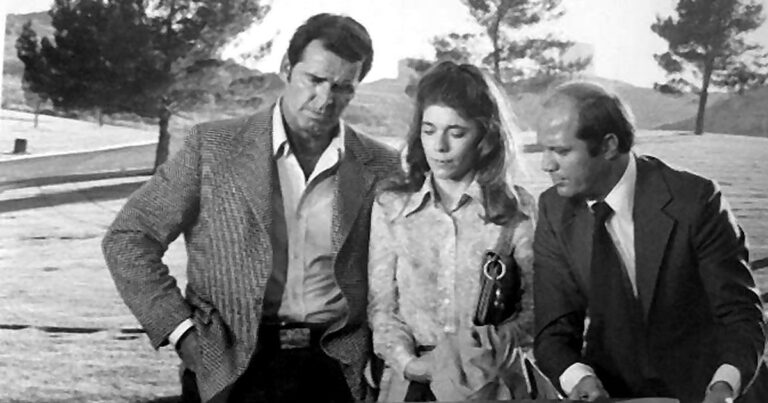
In Exit Prentiss Carr, the fourth episode of The Rockford Files’ first season, James Garner’s character finds himself caught between a suspicious death, an old romantic connection, and authorities who seem determined to close the case.
Originally broadcast on NBC on October 4, 1974, the episode turns a missing-person assignment into a mystery about trust, deception, and the difference between an official explanation and what an investigator believes to be the truth.
And for Jim Rockford, accepting the wrong assignment can quickly become a serious problem.
A Missing Husband and an Unexpected Client
The story begins when Janet Carr seeks the help of private investigator Jim Rockford.
Janet, played by Corinne Camacho, wants Jim to locate her missing husband, Prentiss Carr.
But Janet is not simply another unfamiliar client.
She and Rockford share a romantic history, giving the assignment an uncomfortable personal dimension.
Jim is accustomed to working with clients whose problems are complicated. This time, however, the person asking for help is someone he already knows.
That connection raises questions about whether he can trust everything she tells him.
Janet’s husband has disappeared, and she wants answers.
For a private investigator, locating a missing person is an ordinary enough assignment. But Jim soon discovers that the circumstances surrounding Prentiss are far more disturbing than expected.
His search takes him to Bay City, where the missing man’s trail comes to a shocking end.
Jim Rockford Discovers a Dead Body
Rockford finds Prentiss Carr dead inside a hotel bungalow.
The discovery immediately changes the nature of his investigation.
He was hired to locate a missing husband. Instead, he has found what appears to be a murder scene.
Jim believes the circumstances surrounding the death are suspicious.
Rather than disturbing the scene, he reports the discovery to the police.
He expects the authorities to investigate what he believes is a killing.
But their response is not what he anticipates.
After examining the situation, the police classify Prentiss Carr’s death as a suicide.
The official conclusion leaves Rockford deeply dissatisfied.
He has seen enough to believe that the explanation does not fit what he discovered.
From his perspective, someone may have murdered Prentiss, and the case is being closed under the wrong circumstances.
Now Jim faces a difficult decision.
Should he accept the official ruling and walk away, or continue investigating a death the police believe has already been explained?
The Police and Rockford See Different Stories
One of the episode’s central conflicts is the disagreement between Jim and the authorities.
Rockford believes Prentiss Carr was murdered.
The police have reached a different conclusion.
That difference makes the case especially frustrating for a private detective who must rely on observation, questioning, and persistence rather than official police powers.
Jim cannot simply order the department to reopen its investigation.
He must find information convincing enough to challenge its conclusion.
The situation also raises an uncomfortable question: why are the police so ready to accept suicide?
Is the department mistaken, or is something more troubling influencing its response?
Rockford begins looking more closely at the people connected to Prentiss Carr.
His efforts lead him back toward Janet, whose behavior makes the situation even more complicated.
Jim now finds himself questioning not only the official version of the death but also the person who originally hired him.
Janet Carr Has Questions to Answer
Janet’s personal connection to Rockford adds another layer of tension to the story.
As a former romantic partner, she is someone Jim has reason to remember.
But their shared past does not make her account of events automatically reliable.
According to the episode’s published summaries, Janet is reluctant to explain where she was during a crucial period.
Her uncertain alibi makes Jim increasingly suspicious.
The possibility that Janet knows more than she is willing to reveal turns the investigation into a personal dilemma.
Rockford wants to discover the truth, but doing so may require questioning someone with whom he once had a relationship.
Janet also shows an interest in renewing their romance.
That development makes it even harder for Jim to separate his feelings from the facts he needs to establish.
The episode uses this tension to remind viewers that a familiar face is not necessarily a trustworthy source of information.
And an investigator who allows old emotions to shape his judgment may find himself overlooking something important.
A Mystery With More Than One Dangerous Secret
As Rockford continues working on the case, the circumstances surrounding Prentiss Carr become increasingly complicated.
The investigation draws attention to people associated with the dead man, including individuals connected to his professional and personal life.
Jim realizes that the official explanation has left important questions unanswered.
Why did Prentiss die? Who had a reason to want him dead? And why do some people seem reluctant to discuss what happened?
These questions drive the central mystery.
They also make Rockford’s position more vulnerable.
He is challenging the police’s conclusion while investigating people who may have reasons to conceal information.
Unlike a detective working for a police department, Jim often depends on his own initiative and willingness to take risks.
That independence is one of his greatest strengths, but it can also place him in difficult situations.
In this case, his determination to pursue a suspicious death brings him into conflict with an official ruling and a network of personal secrets.
The Guest Stars Behind Exit Prentiss Carr
James Garner leads the episode as Jim Rockford, the private investigator whose persistence keeps the case moving.
Corinne Camacho appears as Janet Carr, the missing man’s wife and a woman with a past connection to Jim.
Stephen McNally portrays Police Chief Austen Bailey, while Warren Kemmerling plays Lieutenant Earl Furlong.
Mills Watson appears as Sergeant Larsen.
The episode also features Roberta Collins as Nancy Hellman, William Jordan as Terry Warde, and Wallace Rooney as Eric Saunders.
Noah Beery Jr. appears as Joseph “Rocky” Rockford, Jim’s father.
These performers help establish a world in which Rockford must navigate personal relationships, law-enforcement skepticism, and potentially misleading information.
Exit Prentiss Carr was directed by Alex Grasshoff.
The story was credited to John Thomas James, the writing name used by Roy Huggins, while Juanita Bartlett wrote the teleplay.
The episode’s production credits reflect the early creative team behind the series.
Why This Rockford Mystery Is Worth Remembering
One reason The Rockford Files remains recognizable to classic television fans is James Garner’s portrayal of a detective who does not always have the situation under control.
Rockford is observant, resourceful, and persistent, but he also encounters people who mislead him and authorities who question his judgment.
In Exit Prentiss Carr, those qualities become central to the story.
Jim begins with a straightforward task: find a missing husband.
But the discovery of Prentiss Carr’s body makes the assignment more serious.
And when the authorities call the death a suicide, Rockford faces a choice between accepting their conclusion and following his own observations.
His relationship with Janet adds an emotional complication, because the truth may involve someone he once knew intimately.
The episode captures a familiar detective-story dilemma: the available evidence seems to point in one direction, but the official explanation points in another.
For viewers who enjoy mysteries built around conflicting accounts and questionable motives, the situation offers plenty to consider.
It also illustrates why Rockford is an engaging protagonist.
He does not simply accept an answer because someone in authority has provided it.
He wants that answer to make sense.
And when it does not, he keeps asking questions, even when doing so creates more trouble for himself.
Sometimes solving a mystery means finding the evidence that everyone else has overlooked.
Do you remember Exit Prentiss Carr? Would you have trusted the police’s suicide ruling, or followed Jim Rockford’s suspicion that something was terribly wrong?