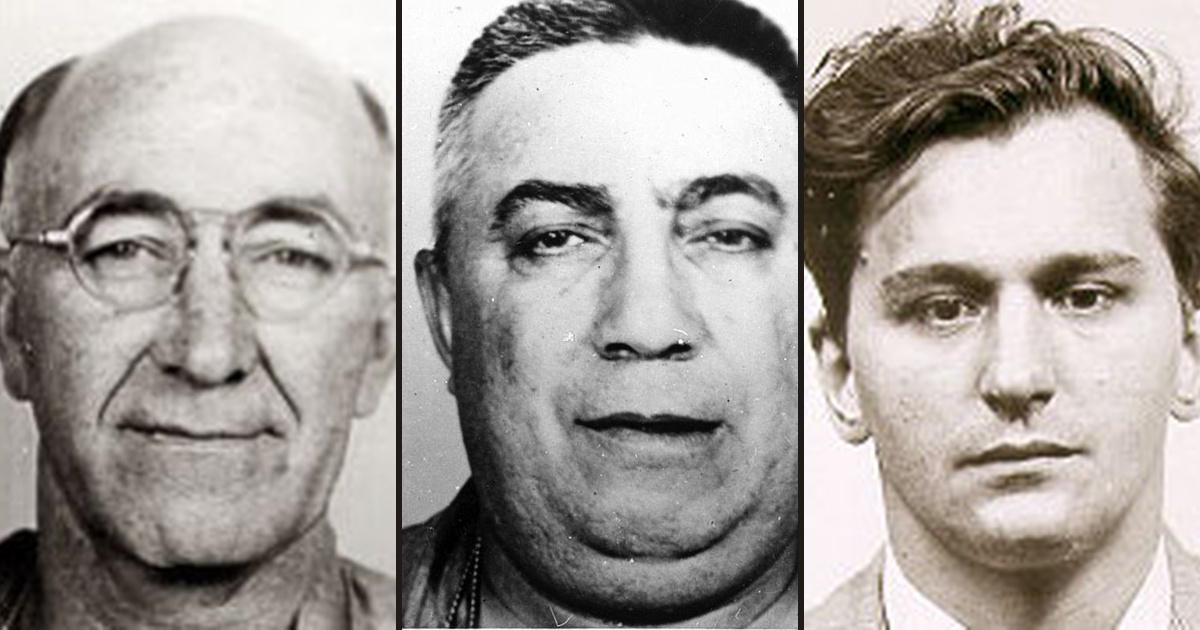
Featured image: Archival portrait collage, left to right: Michael Vincent Geagan, Anthony Pino and Stanley Albert Gusciora. Photos: FBI; cropped, resized and arranged. FBI case history.
For nearly six years, the Brink’s robbery remained a case the authorities could not bring to trial. Millions had disappeared from a Boston security depot. The men responsible were still beyond the reach of a conviction.
Then one of their own began talking.
The Great Brink’s Robbery is remembered for its enormous haul. But the part that finally brought the gang down was painfully human: money, resentment and the collapse of trust.
The Evening More Than $2.7 Million Disappeared
On January 17, 1950, armed robbers entered the Brink’s depot in Boston. Employees were finishing the day’s work when men in dark coats, chauffeur’s caps and Halloween masks took control of the counting area.
The employees were tied up while the robbers gathered their haul. More than $2.7 million in cash, checks and other securities was taken. It was the largest robbery in American history at the time.
That distinction matters: the entire sum was not a mountain of spendable banknotes. Cash made up part of the total, while checks and other financial documents accounted for the rest.
No one was physically injured during the robbery, according to HISTORY’s account. Still, this was an armed crime against people trying to finish an ordinary shift. The masks and the money would dominate the legend, but the employees had been threatened and restrained.
A Few Clues and a Lot of Dead Ends
Investigators recovered rope, adhesive tape and a chauffeur’s cap. Those objects showed what had happened, but they could not immediately identify the men behind the masks.
The FBI’s account describes a striking interruption: a garage attendant rang a buzzer during the robbery, then walked away without realizing what was happening inside.
Police and federal agents pursued leads, questioned possible suspects and examined their accounts of that evening. Suspicion alone could not establish who had committed the crime. That gap between a promising theory and evidence strong enough to take into court kept the investigation open.
The Man Who Felt His Partners Had Cheated Him
Joseph “Specs” O’Keefe had taken part in the robbery. In the years afterward, he was imprisoned for a different crime and became increasingly bitter toward his former partners.
According to Smithsonian Magazine’s account, O’Keefe believed he had been shortchanged on his share of the stolen money. The relationship deteriorated further when an attempt was made on his life in 1954.
The gang had managed to carry out a carefully organized robbery. Living with its aftermath proved much harder. Money that should have bound the participants together had become a source of anger and mistrust.
In January 1956, O’Keefe began telling investigators what he knew. Soon afterward, a grand jury issued indictments against the men involved.
The decisive witness was someone who could describe the crime from within the group. His cooperation gave the investigation an account from a participant rather than another theory from outside it.
The End of the Gang’s Long Silence
The FBI’s Boston history records that eight men went to trial in August 1956. All eight were found guilty and received life sentences for their roles in the case.
For the investigators, the result followed years of work by the FBI, the Massachusetts State Police and the Boston Police. O’Keefe’s cooperation was crucial, but it came within an investigation that those agencies had continued to pursue.
That is what makes the long delay so striking. The robbers had left the building in one evening. Establishing responsibility, finding a cooperative witness and bringing the case through trial took years.
What the Court Record Actually Shows
O’Keefe pleaded guilty and testified for the prosecution. Eight other defendants were convicted in cases arising from the robbery and later challenged their convictions.
The Massachusetts Supreme Judicial Court’s decision in Commonwealth v. Geagan makes an important distinction. Seven defendants were convicted of armed robbery and breaking and entering. Joseph McGinnis was acquitted on those direct charges but convicted on other charges, including being an accessory before the fact to armed robbery.
All eight were convicted of conspiracy to steal. Their roles and convictions were not identical, even though popular retellings often compress the outcome into a single sentence about the gang.
On July 1, 1959, the state’s highest court affirmed the judgments. The case had moved beyond suspicion, arrests and newspaper headlines to convictions that survived that appeal.
The Part of the Story That Stayed Unfinished
Convictions did not mean that all the stolen money came back. The FBI’s detailed case history records recoveries in Baltimore and Boston, including cash concealed behind an office wall. Even afterward, more than $1.15 million in stolen currency remained unaccounted for.
The criminal case reached a verdict; the accounting never became complete. That leaves the Brink’s story with two endings: the men were convicted, while much of the cash was still missing.
Which part of this case stays with you—the years of silence, the missing money, or the gang member who finally decided to talk?
Sources
- FBI: Brink’s Robbery
- FBI: Boston field-office history
- HISTORY: Boston thieves pull off historic Brink’s robbery
- Smithsonian Magazine: The 1950 Brink’s robbery
- Commonwealth v. Geagan, 339 Mass. 487 (1959)