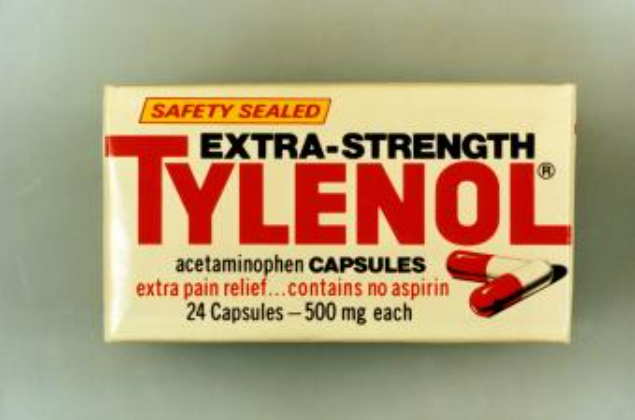
Safety-sealed Extra-Strength Tylenol packaging pictured in the FDA’s history of U.S. food and drug law.
When public health nurse Helen Jensen went to the Janus home in Arlington Heights, Illinois, she found a bottle of Extra-Strength Tylenol on the counter. Three members of the family had collapsed after taking capsules from it. Adam Janus had taken some earlier that day. His brother Stanley and Stanley’s wife, Theresa, had come to the house after Adam’s death.
The bottle gave investigators a way to connect three sudden deaths. It also raised a question that went well beyond the Janus house. Other people could have bought the same medicine and taken it home.
Seven people across the Chicago area
The first known victim was 12-year-old Mary Kellerman. She took Extra-Strength Tylenol for cold symptoms at her home in Elk Grove Village on September 29, 1982. She died that morning. In Arlington Heights, Adam’s death initially looked like a heart attack. When Stanley and Theresa fell ill too, the shared bottle became an important clue.
The other victims were Mary Reiner, who had recently given birth, Mary McFarland, who became ill at work, and Paula Prince, a flight attendant found dead in her Chicago apartment. Laboratory tests established that capsules had been deliberately contaminated with cyanide. Seven people died in the original series of poisonings.
Why the investigation spread beyond Chicago
Health officials had to warn people while investigators were still working out where the contamination had happened. A family might already have a bottle in a medicine cabinet, so removing boxes from drugstore shelves was only part of the response. Johnson & Johnson’s nationwide recall eventually pulled about 31 million bottles of capsules from circulation.
The local laboratories were under pressure too. Michael Petros, who was working in the Chicago Department of Health’s laboratories, later recalled an emergency meeting on October 1. His colleagues arranged round-the-clock shifts for the weekend to help other labs handle the investigation. The FBI worked alongside state and local authorities to trace the contaminated products and investigate the deaths.

The $1 million letter
In October, Johnson & Johnson received a letter threatening further poisonings unless the company paid $1 million. Federal investigators traced it to James William Lewis. A jury convicted him of attempted extortion over the letter, and an appeals court upheld the conviction.
The seven deaths remain unsolved. As recently as September 2026, Chicago police said their detectives were looking at information shared by Idaho authorities to see whether a separate cold case had any connection to the poisonings.
What changed the next time someone opened a bottle
In November 1982, the Food and Drug Administration issued a rule requiring tamper-resistant packaging for most over-the-counter drugs. Tylenol capsules returned in a package with three barriers, including a wrap around the bottle cap and a foil seal underneath. In 1983, Congress made tampering with consumer products a federal crime.
A seal gives the shopper something to look for before taking the medicine. A torn band or broken foil can show that someone has already opened the package. That small, visible detail was the practical change that came out of a case investigators still haven’t solved.
Sources
- FBI Chicago field office history
- WTTW’s reporting and interview with Helen Jensen
- Michael Petros’s account of the public health response
- United States v. Lewis, the federal appeals court opinion
- FDA history of drug packaging regulations
- U.S. Department of Justice on the 1983 Federal Anti-Tampering Act
- Associated Press reporting on the September 2026 case update