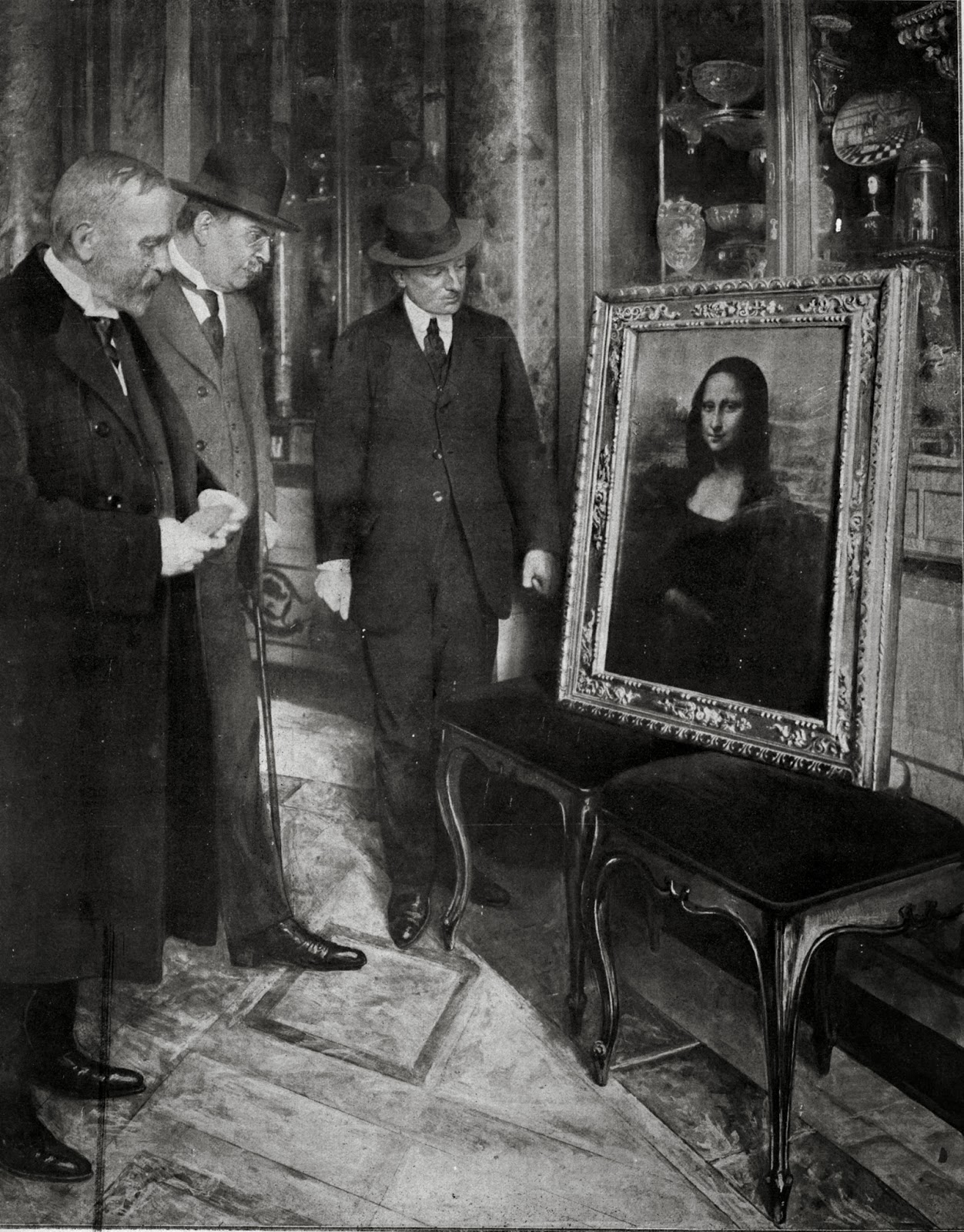
The recovered Mona Lisa at the Uffizi in Florence, December 1913. Photograph by an unknown photographer, public domain.
In November 1913, a man signing himself Leonard V. wrote to a Florentine art dealer named Alfredo Geri. He had seen Geri’s newspaper advertisement and wanted to know whether the dealer would help bring a painting to Italy. The picture he claimed to have was the Mona Lisa. It had been missing from the Louvre for more than two years.
Geri brought the letter to Giovanni Poggi, director of the Uffizi Gallery. When the writer came to Florence, the two men agreed to see what he had. They followed him to a hotel room, where he had a wooden case waiting.
The empty space in the Louvre
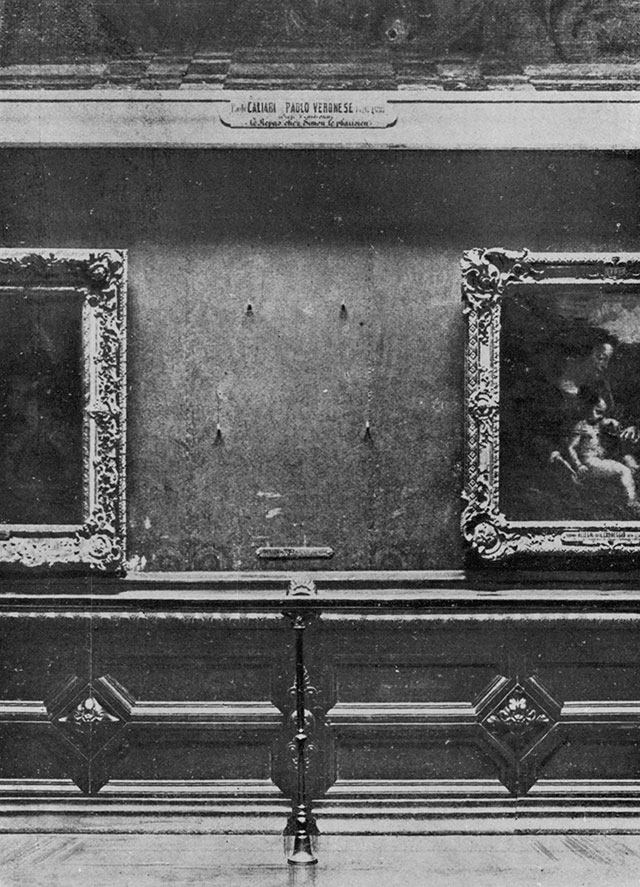
Leonardo da Vinci’s portrait disappeared from the Louvre’s Salon Carré on August 21, 1911. The museum was closed to the public that day. When the disappearance became known the next day, the press carried the story well beyond Paris. The Library of Congress preserves American newspaper coverage that followed the case from the first reports to the recovery.
The thief was Vincenzo Peruggia, an Italian decorator and glazier who had worked at the Louvre. He knew the building through that work. The Florence State Archives say he kept the painting in his Paris room for about two years and three months. While newspapers followed the case, the portrait was still in the city where it had been taken.
A wooden case at the Hotel Tripoli
On December 11, 1913, Peruggia went to Geri’s shop and found Poggi waiting there. Geri left the director’s identity unstated. All three went to the Hotel Tripoli, where Peruggia opened the case and showed them the portrait.
Poggi’s first look suggested it was the original. He brought up the poor light in the room and proposed taking the picture to the Uffizi for a closer examination. Peruggia agreed. At the gallery, Poggi said he would need to speak to Italy’s director general of fine arts before they could go further. Peruggia waited to hear from Geri again. On December 12, the police arrested him.
The motive the court had to weigh
Peruggia presented the theft as an effort to return a work by an Italian artist to Italy. The portrait’s route to France went back centuries. The Louvre’s catalogue says Leonardo took paintings with him when he moved to France in 1516 and that Francis I most likely acquired the Mona Lisa in 1518.
At Peruggia’s trial, the court weighed his claim of patriotism against evidence of a financial motive. The Florence State Archives point to letters in which he told his father he expected to come into money, as well as his efforts to find a buyer. He was convicted in 1914. On appeal, his sentence was reduced to seven months and eight days, which he had already served in custody.
The picture the newspapers had been missing
The recovered portrait was shown in Italy before being sent back to France at the end of December 1913. A photograph from the Uffizi shows it propped on a bench while men stand around it. It is an unusually ordinary setting for a picture that had spent two years at the centre of an international search.
In 1911, the news photographs showed a blank patch of wall. In 1913, they could show the painting again. Between those two images was a letter to an art dealer who knew exactly whom to call.
Sources
- Musée du Louvre’s account of the theft
- Library of Congress guide to contemporary newspaper coverage
- Florence State Archives on Peruggia’s attempts to sell the painting
- Florence State Archives on the letter and arrest
- Florence State Archives on the trial and appeal
- Louvre catalogue entry and provenance
- Florence State Archives on the painting’s return to France