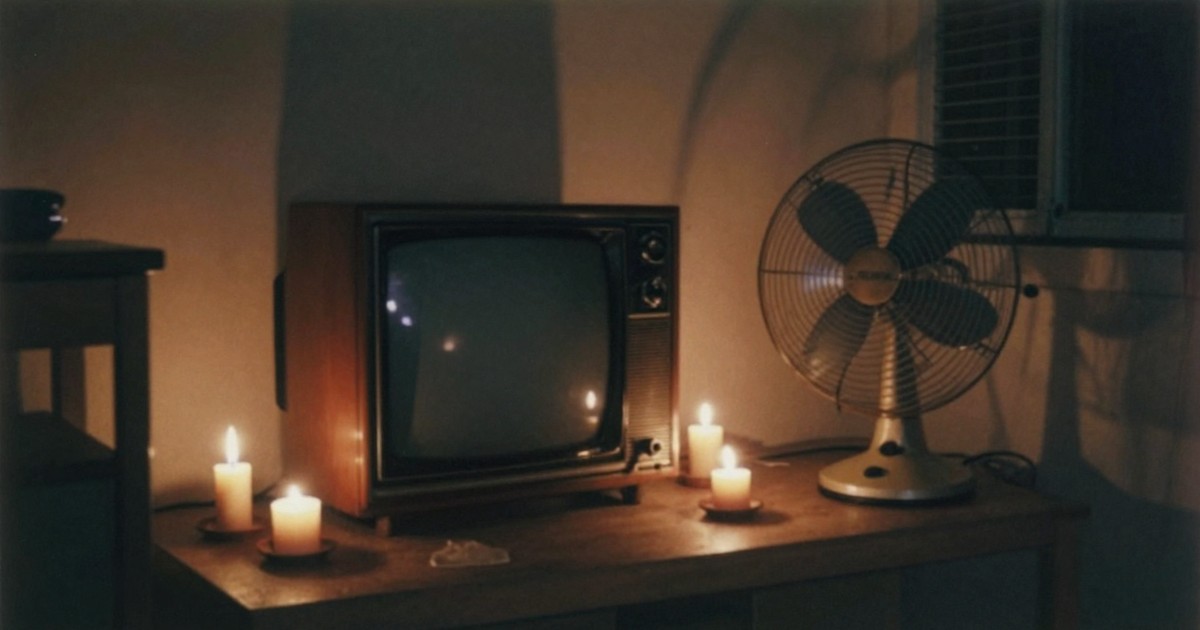
If you were gathered around the television set on the evening of Wednesday, July 13, 1977, you might recall the sweltering heat that seemed to hang over the living room. Across the East Coast, a punishing nine-day heat wave had just begun, with temperatures climbing into the nineties. In New York City, families were settling in for the night, baseball fans were tuned in to the Mets, and nobody could have guessed that within an hour, the greatest metropolis in the country would be plunged into total darkness.
A Cascade of Sparks in the Night
The trouble began far north of the city at 8:34 p.m., when a lightning strike hit the Buchanan South substation along the Hudson River. That strike tripped two circuit breakers handling power from the Indian Point nuclear plant. A loose locking nut and a slow upgrade cycle kept the breakers from reclosing. Moments later, a second bolt of lightning knocked out two major transmission lines, severing power from Indian Point completely.
Consolidated Edison tried to start up a backup fast-start station at 8:45 p.m., but no personnel were there to operate it and the remote start failed. Other plants were down for routine maintenance. Then, at 8:55 p.m., a third lightning strike hit the Sprain Brook substation in Yonkers, severing more critical lines. Because control-room displays did not clearly reveal the severed circuits, operators in New York and the New York Power Pool in Guilderland struggled to coordinate, talking past one another as lines overheated and sagged.
One by one, interconnections failed. At 9:29 p.m., the final link to New Jersey tripped, completely isolating Con Edison from the outside electrical grid. Just minutes later, Ravenswood Generating Unit No. 3—the massive generator affectionately known as “Big Allis”—shut itself down to guard against an imagined electrical short. At 9:37 p.m., almost exactly an hour after that first flash of lightning, the entire Con Edison system failed. The lights went out, leaving only southern Queens, parts of the Rockaways, the Pratt Institute, and a handful of complexes with private generators spared.
Chaos in the Sweltering Streets
The sudden darkness struck a city that was already on edge. New York was enduring a painful financial crisis, a protracted economic downturn, and the terrifying shadow of the Son of Sam killings. Unlike the friendly, almost festive mood of the 1965 blackout, the summer night of 1977 quickly turned chaotic. Store owners had already locked up and gone home, leaving commercial avenues vulnerable under the cover of night.
Vandalism, arson, and looting erupted across 31 neighborhoods, spilling over into the daylight hours of Thursday. In Brooklyn, the Crown Heights and Bushwick neighborhoods were hit especially hard; on Broadway between Bushwick and Bedford-Stuyvesant, fires raged through entire blocks. Clever thieves tied ropes from their cars to storefront security grates to rip them open, and 50 brand-new Pontiacs were driven straight off a Bronx car dealership lot.
The city’s emergency infrastructure was pushed to its limits. Automobile tunnels were shut down due to a lack of ventilation, while four thousand passengers had to be evacuated from stranded subway cars. Both Kennedy and LaGuardia airports closed for roughly eight hours. By the time order was restored, firefighters had responded to 1,037 blazes, 550 police officers were injured, and 3,776 people were arrested in the largest mass arrest in the city’s history. Over 1,600 stores were damaged, four homicides occurred, and damages ultimately totaled more than $300 million.
“We’ve seen our citizens subjected to violence, vandalism, theft, and discomfort,” Mayor Abe Beame announced during the crisis. “We’ve been needlessly subjected to a night of terror in many communities that have been wantonly looted and burned.”
A Little Baseball and a Tune on the Organ
Amid the unrest, there were still moments that felt purely like classic New York. Over at Shea Stadium, the Mets were hosting the Chicago Cubs. At around 9:30 p.m., right in the bottom of the sixth inning with Lenny Randle stepping up to the plate and the Mets trailing 2–1, the ballpark lights vanished.
Rather than panic, the stadium’s beloved organist, Jane Jarvis—known to fans as the “Queen of Melody”—kept spirits up from the darkness. She began playing “Jingle Bells” and “White Christmas,” bringing a touch of winter cheer to a stifling July evening. The game was suspended and finally finished two months later in September, with the Cubs taking the win 5–2.
Waiting for the Dawn and the Legacy Left Behind
Restoring electricity to millions proved to be a slow, painstaking process. Most local television stations were knocked completely off the air, though Channel 2 and Channel 4 managed to return quickly thanks to diesel and gas generators. Around 7:00 a.m. on July 14, power trickled back into parts of Queens, followed by Lenox Hill in Manhattan. It took until 10:39 p.m. Thursday night before the entire city was finally back online.
The political fallout was swift. Mayor Beame blasted Con Edison for “gross negligence,” while the utility called the disaster an “act of God.” Beame would go on to finish third in that year’s Democratic mayoral primary behind Mario Cuomo and Ed Koch, who ultimately won City Hall. The federal government, under President Jimmy Carter’s administration, eventually provided over $11 million in aid to help repair the damage.
The 1977 blackout left an indelible mark on American popular culture. It inspired songs like the Trammps’ disco hit “The Night the Lights Went Out,” movies like the 1978 thriller Blackout, and countless books and television episodes. Con Edison revamped its restoration procedures to ensure operators would be far better trained for future emergencies.
For those who lived through it, that hot July night remains impossible to forget. Were you living in New York, listening to the news on a transistor radio, or watching the headlines unfold on television from across the country? We would love to hear your memories in the comments below.