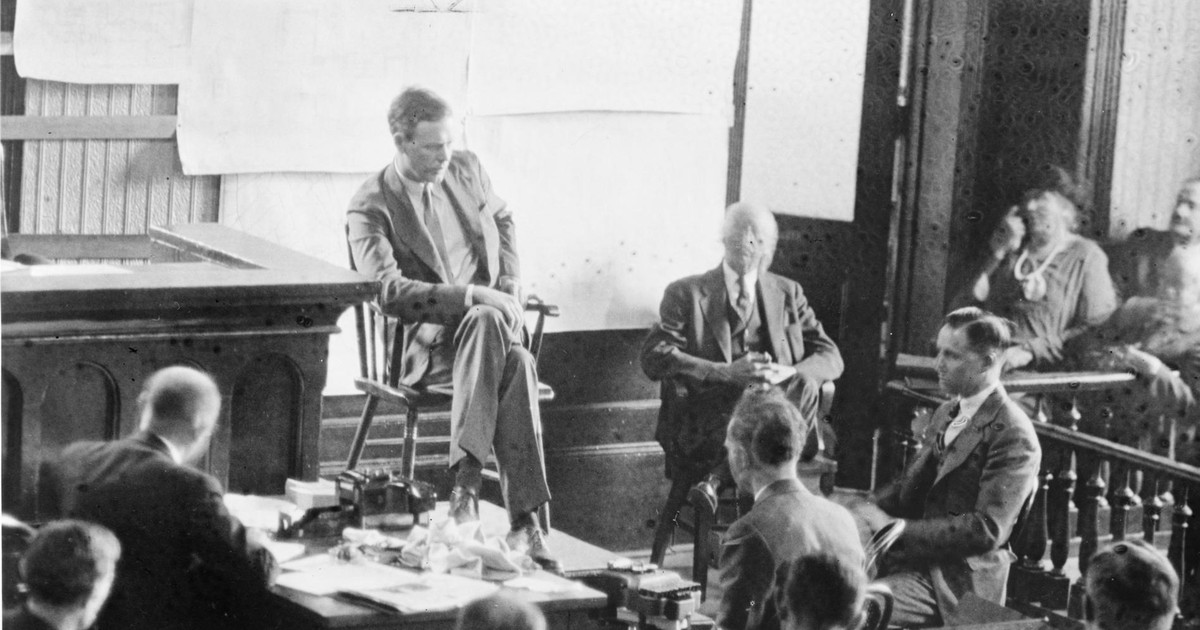
Top photo: World Telegram staff photographer / Public domain, via Wikimedia Commons
On January 2, 1935, hundreds of spectators, reporters, and lawmen packed into the Hunterdon County Courthouse in Flemington, New Jersey. Every hotel room in the small town was taken. The press immediately branded the proceeding the “Trial of the Century,” while writer H. L. Mencken went further, labeling the saga “the biggest story since the Resurrection.” Sitting in the room was the grieving father, Colonel Charles Lindbergh—the world-famous aviator whose transatlantic flight had captivated humanity less than eight years earlier. Nearby sat the prisoner, Bruno Richard Hauptmann, an immigrant carpenter from the Bronx who stood accused of capital murder.
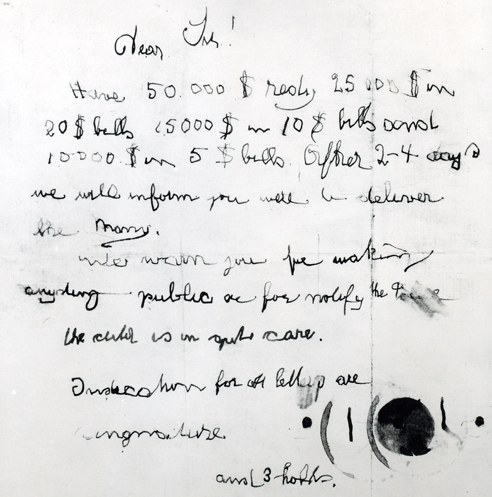
The tragedy had begun on the night of March 1, 1932, when twenty-month-old Charles Augustus Lindbergh Jr. was stolen from his crib at the family’s rural home near East Amwell. A crude wooden ladder and an envelope containing a poorly spelled ransom note demanding $50,000 were discovered at the scene. Though the family later paid the demanded sum via intermediary John F. Condon, the search ended in heartbreak on May 12, 1932. A truck driver discovered the child’s decomposed remains discarded along a road in neighboring Hopewell Township, with a severely fractured skull indicating a fatal blow to the head.

The State Builds Its Case
For more than two years, the investigation made little progress as detectives struggled to trace the serial numbers of the ransom money. The breakthrough finally arrived in September 1934, when a gas station attendant noted down a car license plate after receiving a suspicious gold certificate. That plate belonged to Hauptmann. When police arrested the German carpenter, they seized a twenty-dollar ransom bill from his person and later discovered more than $14,000 of the extortion money tucked inside a suitcase in his garage.
At trial, New Jersey Attorney General David T. Wilentz led the charge against Hauptmann before Judge Thomas Whitaker Trenchard. Hauptmann’s defense was spearheaded by Edward J. Reilly, who had been retained through an arrangement involving the New York Daily Mirror in return for the rights to publish the defendant’s personal account. Wilentz set out to prove not merely that Hauptmann held the ransom money, but that he was the sole perpetrator who crept up the ladder into the second-story nursery.
The prosecution’s presentation relied on three core pillars: the cash, handwriting, and timber. Eight handwriting analysts, including prominent specialist Albert S. Osborn, testified that the unusual phrasing and penmanship of the ransom notes matched samples written by Hauptmann. Furthermore, witnesses identified Hauptmann as the man called “John” who had received the cash at St. Raymond’s Cemetery in the Bronx, and others testified they had seen him near the Lindbergh property around the day of the abduction.
The Silent Testimony of the Ladder
Perhaps the most extraordinary evidence presented to the jury came from the Forest Products Laboratory. Expert Arthur Koehler took the stand with photographs and technical measurements to analyze the wooden ladder found on the Lindbergh grounds. Koehler testified that a section of the ladder was an exact match to an attic floorboard taken from Hauptmann’s home.
The state proved that the tree growth rings, wood species, milling markings, and grain patterns were identical between the attic plank and the ladder rail. More damaging still, four unusual nail holes in the ladder rail lined up precisely with the framing joists inside Hauptmann’s attic. Additionally, authorities revealed that John F. Condon’s contact information was penciled onto an interior closet door in the carpenter’s residence, alongside a notebook sketch that prosecutors asserted depicted a ladder.
The Defense and the “Fisch Story”
When the state concluded its presentation, Hauptmann took the witness stand to maintain his innocence. He acknowledged writing Condon’s address inside the closet, explaining that he likely came across the information while reading coverage of the crime in the newspaper and simply jotted it down while standing nearby, though he could offer no explanation for how the telephone number got there. He insisted the notebook drawing was merely a doodle by a child.
To explain the fortune hidden on his property, Hauptmann laid the blame entirely on his late acquaintance and former business associate, Isidor Fisch. He testified that Fisch had entrusted him with a shoe box before departing for Germany in late 1933, where Fisch died of tuberculosis in March 1934. Hauptmann claimed he discovered the cache of currency only after Fisch had passed away, keeping the money to satisfy an unpaid debt of approximately $7,500 that Fisch owed him from a business venture.
That narrative quickly fell apart during cross-examination. Hauptmann’s wife, Anna, testified that while she used a hook near the kitchen broom closet shelf every day for her apron, she never recalled seeing the shoe box. State rebuttal witnesses also proved that Fisch had lived in complete poverty, barely able to pay his $3.50 weekly room rental and leaving no funds for his medical care abroad.
The Verdict and Aftermath
In his closing summation, defense attorney Reilly stressed that no fingerprints belonging to Hauptmann had been recovered from the nursery, the ransom notes, or the ladder. He argued that the entire case was constructed on circumstantial evidence without direct eyewitness proof of the kidnapping itself. The jury was unconvinced. On February 13, 1935, after weeks of testimony, they returned a verdict of guilty for first-degree murder, and the court immediately sentenced Hauptmann to death.
Over the subsequent fourteen months, Hauptmann exhausted his legal appeals before the New Jersey Court of Errors and Appeals and the New Jersey Board of Pardons. New Jersey Governor Harold G. Hoffman voiced doubts regarding whether a single individual could have pulled off the crime and granted temporary reprieves while ordering further reviews, but no new evidence halted the judgment. Hauptmann reportedly rejected a lucrative proposal for a published confession as well as an offer of life imprisonment in exchange for admitting guilt.
On April 3, 1936, Bruno Richard Hauptmann was executed in the electric chair at the New Jersey State Prison in Trenton, maintaining to his spiritual advisor that he was entirely innocent of the charges. The sensational trial brought enduring grief to the Lindbergh family, led directly to federal legislation regarding interstate kidnapping, and established a dark benchmark in American legal history. What do you think about the physical evidence used to secure this historic verdict? We welcome your thoughts in the comments below.