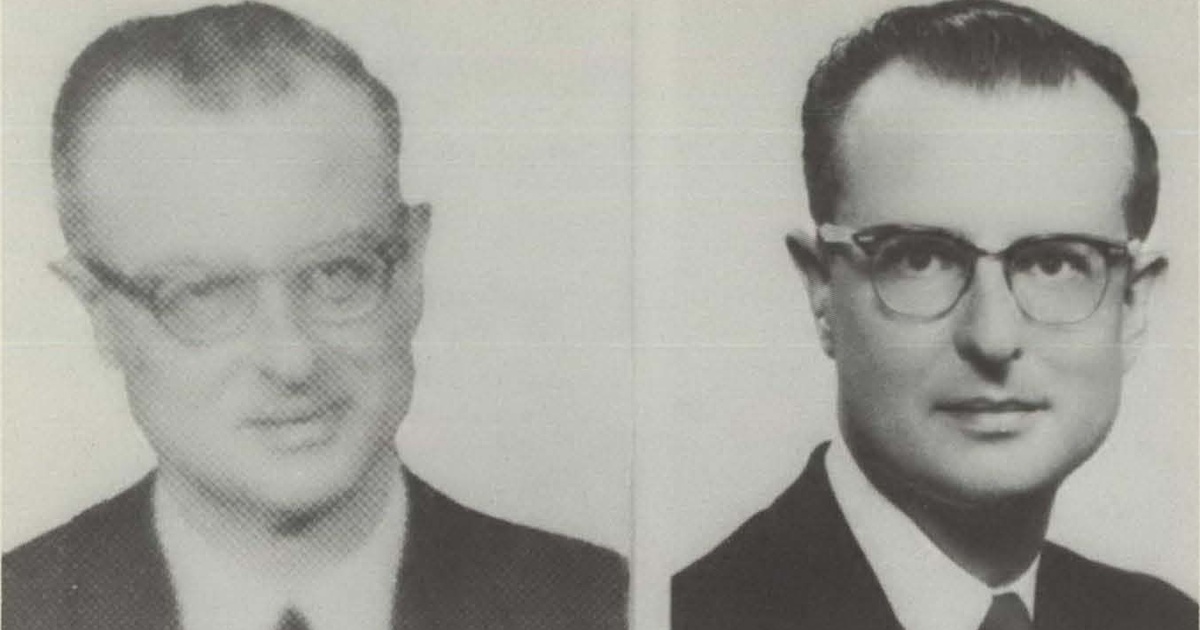
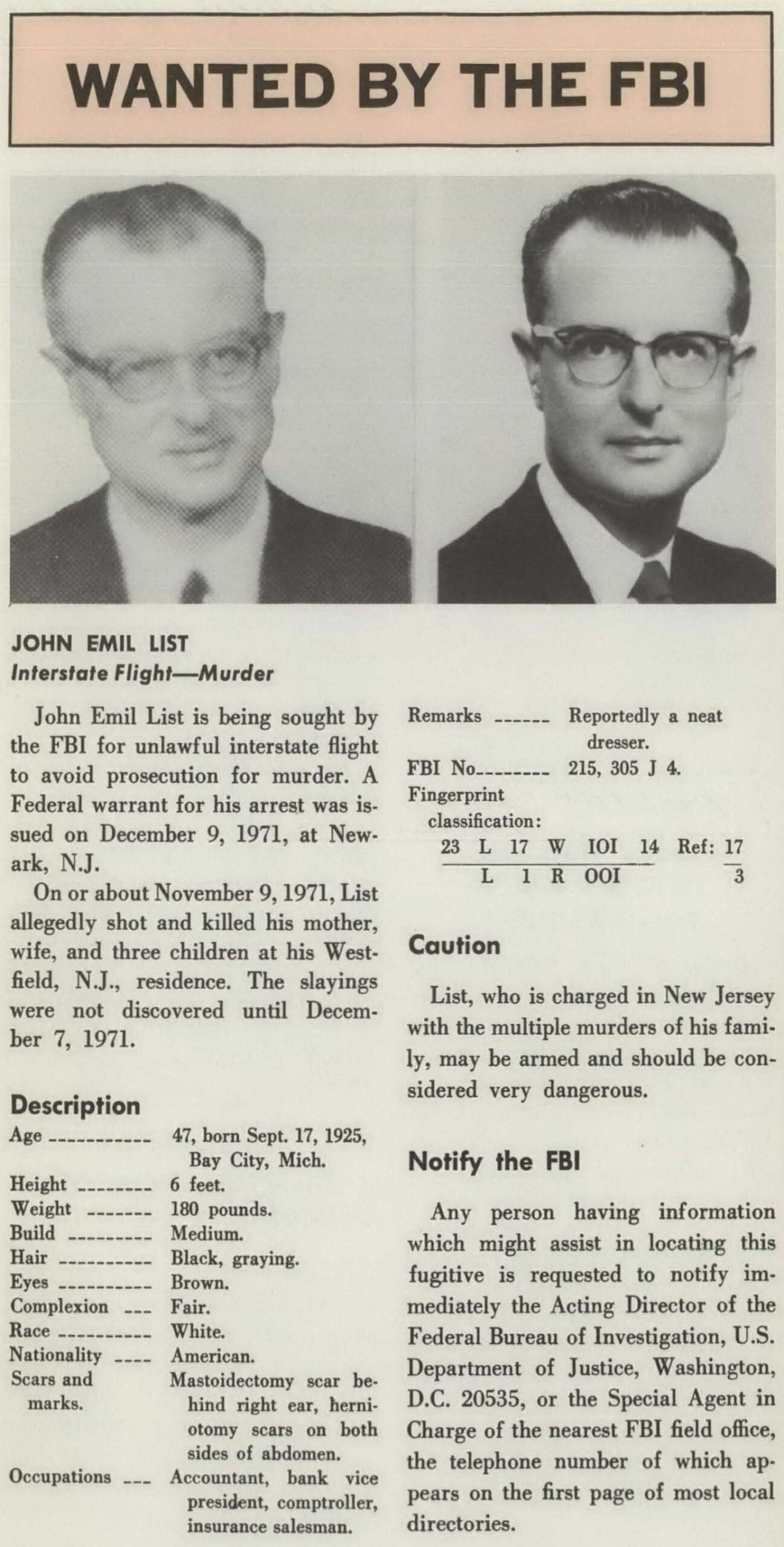
Two archival portraits of John List from the FBI Law Enforcement Bulletin, October 1972, page 32. Cropped from the historical FBI notice. Public-domain U.S. government publication. These are older portraits, not photographs taken at his 1989 arrest.
For more than 17 years, John List lived under another name while investigators searched for the man who had killed five members of his family. The break came after a television program showed viewers a face made from plaster. It was a sculptor’s idea of what the missing man might look like after so many years.
In May 1989, America’s Most Wanted put that face on the screen. A former neighbor recognized something familiar. Less than two weeks later, the search reached an accountant working near Richmond, Virginia. The man his neighbors knew as Robert P. Clark was John List. UPI’s contemporary arrest report
The Family He Left Behind in Westfield
On November 9, 1971, List killed his wife, his mother and his three children at their home in Westfield, New Jersey. Their deaths were not discovered until December 7. An FBI notice published the following year recorded those dates and the federal warrant issued on December 9 for his flight from prosecution. By the time the search was underway, List had a considerable head start. FBI Law Enforcement Bulletin, October 1972, page 32
There was a terrible gap between the life List appeared to have and the one he was concealing. ABC News later reported that he had lost his job but continued leaving home each morning as though he were going to work. His family lived in a large house, while he could no longer meet their bills.
List left a letter confessing to the killings. In a much later interview with Connie Chung, he connected his actions to his financial failures and his religious beliefs. Those were the explanations he offered for his own crime. His family had been denied any chance to decide their future. ABC News’ report on the interview
A Familiar Occupation Under a Different Name
List eventually built another life in Colorado under the name Robert P. Clark. He worked again as an accountant, attended church and remarried in 1985. He and his second wife later moved to Virginia. ABC’s account describes a fugitive who returned to many of the ordinary habits of his earlier life, even as he concealed the reason he had abandoned it.
That is one of the disturbing features of the case. The person people encountered in their daily lives was also the person investigators were looking for. Recognizing him required someone to connect a neighbor’s familiar face with a crime committed in another state years earlier. ABC News
Investigators Needed an Older Face
Old photographs become a problem during a long search. Hair changes, faces age and the image on a wanted notice can grow less useful with every passing year. In 1987, the FBI’s Newark office asked its laboratory to produce an updated image of List.
The laboratory used computer-assisted imaging to suggest how he might look. The FBI’s later account says a woman saw that image in a supermarket publication and thought her neighbor, Clark, resembled List. The suspicion had already begun before the television broadcast. FBI Law Enforcement Bulletin, January 1994, pages 5–6
The Television Appearance That Brought a Tip
For America’s Most Wanted, Philadelphia sculptor Frank Bender prepared a plaster bust. The challenge was to give viewers a recognizable older face using photographs from the past. Contemporary reporting also noted that Bender drew on advice from a psychologist.
The bust appeared on May 21, 1989. Reporting after the arrest described the striking resemblance between the sculpture and a photograph of List taken afterward. More practically, the broadcast gave a viewer enough confidence to pass on a lead. A television image could only suggest an identity, but it could direct investigators toward someone worth checking. Deseret News’ June 1989 report
A New Address, Then Fingerprints
According to the FBI, List’s former neighbor asked her son-in-law to contact the bureau with Clark’s new address in Virginia. Agents then had somewhere specific to look. List denied his identity when confronted, but fingerprints from an application for a gun permit made before the killings established who he was. FBI account of the identification
Federal agents arrested him on June 1, 1989, at the office where he worked as an accountant. The long search had ended with a viewer’s tip followed by the evidence needed to test it. UPI
The Verdict After the Search
In April 1990, a jury found List guilty of five counts of first-degree murder. He received five consecutive life sentences. Associated Press sentencing report
List died in March 2008 at age 82 while serving his sentence. The Associated Press reported that he had been transferred from prison to a hospital in Trenton, New Jersey. Associated Press report
The bust is the detail many people remember. Behind it were five lives lost, a family’s disappearance and years spent looking for the man responsible. Do you remember seeing this case on America’s Most Wanted, or first hearing about the sculpture that helped identify him?