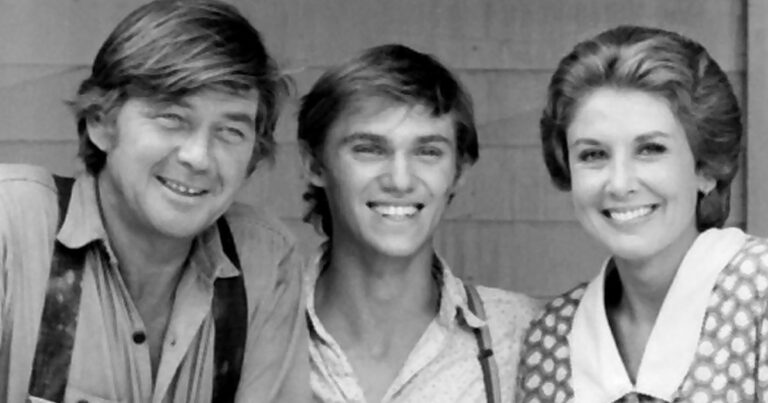
Top photo: CBS Television / Public domain, via Wikimedia Commons
Opening your home to a stranger is an act of kindness. But what happens when the person you help betrays your trust?
That difficult question lies at the heart of The Boy from the C.C.C., the eighth episode of The Waltons’ first season.
Originally broadcast on CBS on November 2, 1972, the episode introduces Gino, a troubled young runaway portrayed by Michael Rupert.
Gino has escaped from a Civilian Conservation Corps camp and arrives on Walton’s Mountain with little reason to trust anyone.
The Walton family offers him food and hospitality. But his suspicion of others soon creates a serious problem.
Meanwhile, young Elizabeth becomes attached to a sick raccoon she desperately wants to save.
These two storylines eventually come together in a lesson about grief, kindness, and the possibility of changing someone’s life.
A Runaway Appears on Walton’s Mountain
The story begins as John-Boy, Mary Ellen, and Elizabeth are returning home after buying Elizabeth a new pair of shoes.
The family dog, Reckless, chases a raccoon into the woods.
During the encounter, John-Boy discovers a young stranger named Gino.
Gino has been trying to catch the raccoon for food.
The situation immediately reveals something about his circumstances. Unlike the Walton children, who are returning from an ordinary family errand, Gino is focused on finding something to eat.
He has run away from a Civilian Conservation Corps camp and is now trying to survive on his own.
John-Boy and the girls offer to take him home for food.
It is a straightforward act of hospitality, but Gino does not respond with the easy trust the family might expect.
His experiences have made him cautious about other people’s intentions.
The Waltons may see a hungry young man who needs help, but Gino has learned to view the world very differently.
Gino Has Learned Not to Trust People
Gino comes from New York City’s Hell’s Kitchen neighborhood.
His background has been marked by hardship, including the murder of his father by a gangster.
Those experiences help explain why he has difficulty trusting the kindness of strangers.
At the Walton home, the family tries to make him comfortable and learn more about him.
But Gino reveals very little.
He has developed a guarded attitude that makes it difficult for others to understand what he is thinking.
The contrast between Gino and the Walton children is important.
They have grown up in a household where helping one another is part of everyday life.
Gino has experienced a much harsher environment and is accustomed to protecting himself.
For him, accepting help may feel unfamiliar.
The Waltons’ generosity does not immediately erase his suspicion.
That difference is what makes his arrival more complicated than simply offering a hungry stranger a meal.
Elizabeth Tries to Save a Sick Raccoon
While the family becomes acquainted with Gino, Elizabeth has her own concern.
The raccoon involved in the earlier encounter is sick.
Elizabeth brings the animal home and names him Pete.
She hopes to nurse him back to health.
Her attachment to the raccoon creates a second emotional storyline running alongside Gino’s visit.
For Elizabeth, Pete is not merely an injured wild animal.
He has become a creature she feels responsible for protecting.
Her concern reflects the affection children can develop for animals, especially when they believe those animals need their help.
But caring deeply does not always mean being able to change the outcome.
As Elizabeth concentrates on Pete, Gino continues struggling with his own understanding of trust and kindness.
Their two experiences eventually become connected.
Gino Makes a Serious Mistake
Despite the family’s hospitality, Gino betrays their trust.
One evening, he notices Olivia hiding five dollars in her savings jar on a kitchen shelf.
Later, after she has gone to bed, he enters the locked house and attempts to steal the money.
John Walton catches him.
The discovery changes the family’s situation immediately.
Gino is no longer simply a troubled runaway receiving help.
He has attempted to take money from people who welcomed him into their home.
John considers turning him over to Sheriff Bridges.
His reaction is understandable. He has a responsibility to protect his family and their belongings.
At the same time, Gino’s difficult past complicates the question of what should happen next.
The young man has done something wrong, but the family also knows that his life has been marked by hardship.
The episode does not ignore the seriousness of his attempted theft.
Instead, it presents a situation in which accountability and compassion must be considered together.
Elizabeth’s Heartbreak Changes Everything
The story takes an emotional turn when Pete the raccoon dies.
Elizabeth is devastated.
She runs away to cry, overwhelmed by the loss of the animal she had tried to save.
Gino approaches her and attempts to explain death.
As he speaks with Elizabeth, he begins opening up about his own difficult upbringing.
This conversation becomes an important turning point.
The young man who had been so unwilling to trust the family now reveals something personal about himself.
John and other family members overhear their conversation.
They see a different side of Gino.
Until this moment, his attempted theft has made him appear dishonest and ungrateful.
But his concern for Elizabeth shows that he is also capable of kindness.
The experience does not undo what he has done.
It does, however, give John a reason to reconsider how he should respond.
John Walton Makes a Different Decision
When Sheriff Bridges arrives, John has a decision to make.
He could turn Gino over to the authorities for attempting to steal the family’s savings.
But after hearing the young man’s conversation with Elizabeth, John changes his mind.
He decides not to turn Gino in.
It is a significant act of forgiveness.
John has not forgotten Gino’s attempt to steal. Instead, he recognizes that Gino may benefit from being treated as someone who can make a better choice.
The family’s compassion gives the runaway an opportunity to reconsider his actions.
Gino eventually decides to return to the Civilian Conservation Corps camp.
The decision marks an important change from the young man who arrived on Walton’s Mountain suspicious of everyone.
His experiences with the Waltons have shown him that not every offer of help comes with a hidden motive.
Jim-Bob Has a Small Business Idea
The episode also includes a lighter secondary storyline involving Jim-Bob Walton.
Jim-Bob tries to make money by selling bluing, a product used in laundry and sometimes as a coloring agent.
He approaches the Baldwin sisters with his business idea.
The subplot provides a contrast to Gino’s much more serious situation.
While Gino struggles with hardship and distrust, Jim-Bob is experimenting with a way to earn money.
Both stories involve money, but they approach the subject from very different directions.
Jim-Bob’s efforts reflect the everyday resourcefulness of the Walton children during the Depression.
The episode-specific guide identifies this as a secondary plot rather than the central conflict.
What Happens to Gino Afterward?
One interesting detail about The Boy from the C.C.C. comes from John-Boy’s closing narration.
After leaving the Walton family, Gino continues writing to them for a time.
His letters first come from the CCC camp.
Later, he writes from New York City, where he returns after the Depression ends.
This detail gives the episode a sense of continuity beyond Gino’s brief stay on the mountain.
He does not simply disappear from the family’s memories after leaving their home.
His correspondence suggests that the connection he formed with them continued afterward.
The closing narration also reflects on the former CCC camp site, which later became part of a national park.
It is a quiet reminder of the era in which the story takes place.
The Guest Star and Creative Team
Michael Rupert portrays Gino, the troubled runaway whose arrival drives the central story.
Richard Thomas plays John-Boy Walton, while Ralph Waite portrays John Walton and Michael Learned plays Olivia.
Kami Cotler appears as Elizabeth, whose relationship with the sick raccoon becomes an important part of the episode.
Judy Norton portrays Mary Ellen, while David W. Harper plays Jim-Bob.
Will Geer appears as Grandpa Walton, and Ellen Corby plays Grandma Walton.
Joe Conley is credited as Ike Godsey.
The episode was written by William Welch and directed by Harry Harris.
The Boy from the C.C.C. combines the story of a runaway learning to trust others with Elizabeth’s experience of grief and the family’s response to wrongdoing.
Why The Boy from the C.C.C. Is Worth Remembering
At its heart, this episode asks whether a person’s past mistakes should determine how others treat them.
Gino arrives with an understandable distrust of people, but his behavior creates real problems for the Walton family.
John must decide how to respond after discovering the attempted theft.
The turning point comes not from excusing the attempted theft, but from seeing Gino’s compassion toward Elizabeth.
The young man’s kindness reveals that he is more complicated than his worst decision.
For viewers who remember The Waltons as a series about family and community, the episode offers a recognizable message about second chances.
Elizabeth cannot save Pete, but her grief helps create a moment of understanding between Gino and the family.
And John demonstrates that forgiveness can sometimes encourage responsibility more effectively than punishment alone.
The story does not suggest that trust should be given without thought.
It shows how trust can begin to grow when people are willing to see more than someone else’s mistakes.
Sometimes the most meaningful gift a family can offer is the opportunity to choose a better path.
Do you remember The Boy from the C.C.C.? Would you have given Gino another chance after John caught him attempting to steal the family’s savings?
Sources
- allaboutthewaltons.com
- rottentomatoes.com
- rottentomatoes.com
- tvmaze.com
- tvguide.com
- Wikipedia: List of The Waltons episodes
- imdb.com