Top photo: NBC Television / Public domain, via Wikimedia Commons
When someone goes missing, the first question is usually where they went. But for private investigator Jim Rockford, one missing-person case raises another question almost immediately: who else is looking for the same person, and why?
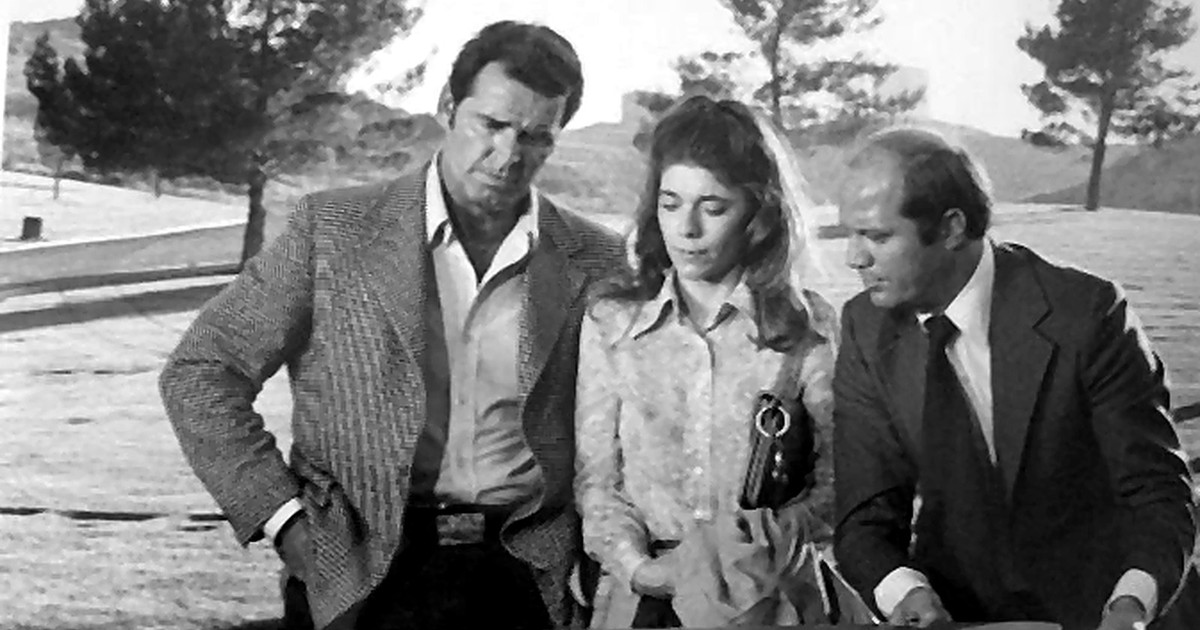
That is the premise of Tall Woman in Red Wagon, the fifth episode of The Rockford Files’ first season. Originally broadcast on NBC on October 11, 1974, it finds James Garner’s detective helping a newspaper reporter search for a missing friend.
The reporter has no intention of handing over the case and waiting quietly for results. Meanwhile, people connected to the missing woman’s troubled past have their own reasons for wanting to locate her.
The episode turns a seemingly straightforward assignment into a story about competing interests, uncomfortable questions, and the difficulty of deciding whom to trust.
A Reporter Brings Rockford a Missing-Person Case
The story centers on Sandra Turkel, a newspaper reporter played by Sian Barbara Allen. Sandra wants to find her missing friend Charlotte Duskey, portrayed by Susan Damante.
She hires Jim Rockford to investigate. The assignment seems to fit the work of a private detective: establish what is known, follow leads, and try to locate a person who cannot be reached.
But Sandra is far from an ordinary client. She insists on accompanying Jim and helping with the search herself.
For a reporter, the desire to ask questions is understandable. Sandra is used to pursuing information rather than simply accepting somebody else’s account of events.
For Rockford, however, having the person who hired him involved in his day-to-day work presents a challenge. He must investigate the disappearance while also dealing with Sandra’s determination to take part.
That difference in approach gives the case an engaging personal dimension before the larger mystery has even been resolved.
Sandra Refuses to Stay on the Sidelines
One distinctive part of the episode is Sandra’s insistence on joining the investigation. She does not merely give Jim a name and a description, then ask him to telephone when he has news.
She wants to be involved in finding her friend.
That determination can be read in two ways. It demonstrates that the missing woman matters to Sandra, but it can also complicate the work of the investigator she has hired.
Rockford’s job depends on asking difficult questions, deciding which leads are worth following, and recognizing when somebody may be withholding information.
Sandra’s reporting background means she is drawn to those same questions. Yet two people who want answers are not necessarily going to agree on how to get them.
This creates a familiar Rockford Files situation: Jim must manage a client’s expectations while trying to do his actual job.
The friction makes the search more personal without changing the central mystery. Charlotte is still missing, and the people looking for her are not all motivated by the same concerns.
Charlotte’s Past Raises New Questions
According to the publicly available episode summaries, Charlotte has a troubled past, and several of her former acquaintances are also eager to find her.
That is an important detail because it changes the shape of the assignment.
If Sandra were the only person looking for Charlotte, Jim might be dealing with a straightforward case of a friend who has disappeared. But the existence of other interested parties raises questions about what happened before Charlotte went missing.
What do those people know? Why are they looking for her? And what might Charlotte want to avoid?
The summaries do not establish a complete answer to every question, so the mystery is best discussed without inventing motives or identifying a final outcome.
What is clear is that Charlotte’s history matters to the search. It gives Rockford reason to examine not only where she might be, but also the relationships surrounding her disappearance.
That is a strong premise for detective television: discovering one fact may lead to several more questions.
A Case That Calls for More Than One Approach
Rockford is a private investigator, but this is not a story about him simply waiting for someone else to provide the answer.
The Classic TV Archive describes the episode as one in which Jim uses a series of disguises while investigating the disappearance of a red-haired woman. Rotten Tomatoes also identifies disguises as part of the episode’s central setup.
The detail fits the kind of practical improvisation that distinguishes Jim from an idealized, all-powerful detective.
He is willing to change his approach when a direct question may not produce the information he needs.
At the same time, the existence of several people looking for Charlotte means every new conversation has a potential complication. Someone who appears helpful may have interests that differ from Sandra’s.
The case therefore depends not just on finding clues, but on interpreting the people connected to them.
That combination of investigation and uncertainty is part of the appeal of The Rockford Files.
James Garner and Sian Barbara Allen
James Garner returns as Jim Rockford, the working private detective whose cases rarely remain as simple as they first appear.
Sian Barbara Allen plays Sandra Turkel, the determined reporter who brings him the assignment and insists on taking part.
Susan Damante is credited as Charlotte Duskey, the missing woman at the center of the search.
The episode’s publicly accessible cast lists also identify John Crawford as Dr. Kenilworth, Angus Duncan as Joe Baron Jr., Dave Morick as James Darrow, James Murtaugh as Steve McWilliams, and Rudy Diaz as Matty.
These credits help distinguish the episode from other early Rockford investigations, where similarly complicated clients and guest characters can be easy to confuse.
The important distinction is that these names belong to Tall Woman in Red Wagon, not to the preceding episode, Exit Prentiss Carr, or to The Countess.
The People Who Made the Episode
Tall Woman in Red Wagon was directed by Jerry London. The story credit goes to John Thomas James, a pen name associated with series co-creator Roy Huggins, and the teleplay is credited to Stephen J. Cannell.
The episode appeared early in the original NBC run, when viewers were still getting acquainted with Rockford’s approach to investigations.
Rather than presenting a detective who always has every situation under control, the series often places Jim in awkward positions involving clients, questionable leads, and difficult personalities.
In this case, an insistent reporter and a missing woman’s troubled history are enough to create the essential tension.
The premise gives the guest performers something useful to contribute without requiring the audience to know every detail of Charlotte’s earlier life in advance.
Why Tall Woman in Red Wagon Is Worth Revisiting
For classic mystery fans, Tall Woman in Red Wagon offers a recognizable question with a compelling twist.
One woman is missing, but the people who want to find her may be searching for very different reasons.
Sandra wants Jim’s professional help, yet refuses to remain outside the investigation. Jim must pursue answers while dealing with a client who has a strong mind of her own.
And Charlotte’s troubled past suggests that locating her could be more complicated than following an ordinary trail.
The result is the kind of situation that suits James Garner’s understated detective. The drama comes not only from the missing-person mystery, but also from the relationships surrounding it.
For viewers who remember the show’s early seasons, that mix of persistence, uncertain motives, and character-driven friction is part of what makes Rockford distinctive.
Finding someone is one thing. Understanding why so many people want to find them is another.
Do you remember Tall Woman in Red Wagon? Did Sandra’s insistence on joining the investigation make the case more interesting to you?