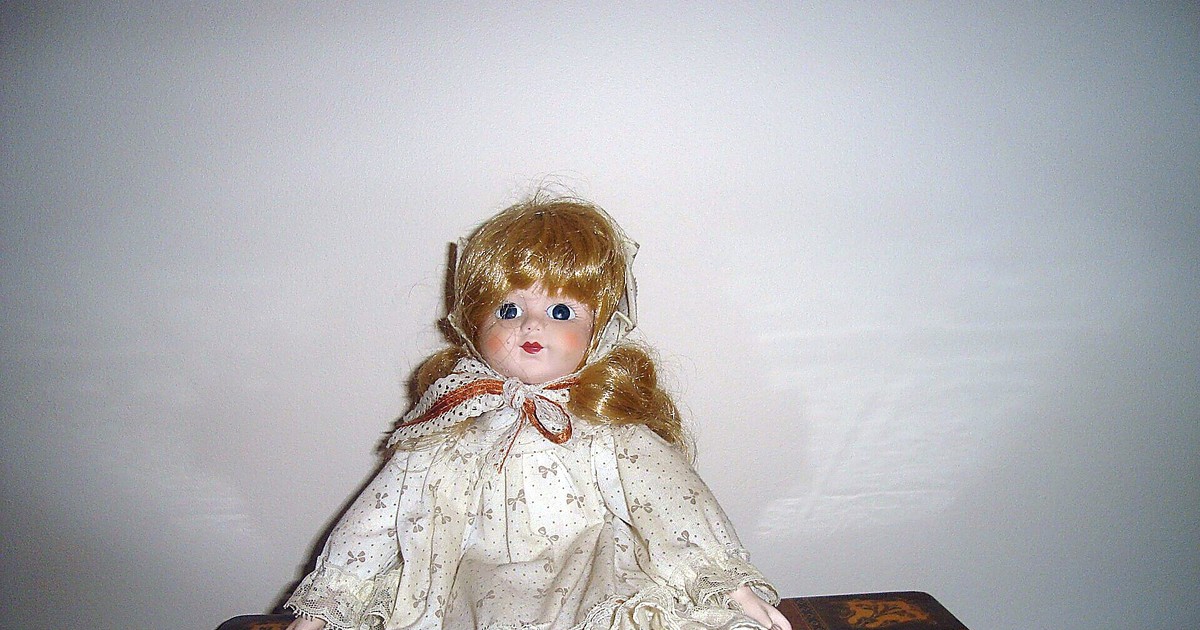
Top photo: Jorcoga / Public domain, via Wikimedia Commons
Some warnings are impossible to ignore. Especially when they appear on something that already looks frightening.
Imagine accepting a house-sitting job and discovering a life-size doll sitting quietly inside the home. The doll looks disturbingly realistic, and a warning tells visitors not to touch it.
Would you follow the instruction, or would curiosity get the better of you?
That question drives Don’t Play with Dolls, a 2026 horror short from ACMofficial, written and directed by Alex Magaña, with additional writing by Jed Brian.
The film follows Abigail, played by Angel Strittmater, whose house-sitting assignment becomes a terrifying encounter with a mysterious doll.
Released on January 15, 2026, the short uses a simple premise to create an uncomfortable situation: an unfamiliar house, a strange object, and a rule that should never be broken.
A House-Sitting Job Takes an Unsettling Turn
The story begins with Abigail arriving at a house where she has been hired to look after the property.
House-sitting usually sounds like a straightforward responsibility. Someone stays in a home while its owner is away, keeping an eye on the property until the owner returns.
But Abigail discovers something unusual inside.
A remarkably lifelike doll is positioned on a chair.
At first, its realistic appearance makes it particularly unsettling. A figure that resembles a person but remains completely motionless can be difficult to interpret at a glance.
Then Abigail notices the warning associated with the doll.
It tells her not to touch it.
That instruction immediately changes how the doll is perceived.
Without the warning, it might simply appear to be an unusual decoration. With the warning, it becomes something that demands caution.
Abigail has entered a house where an ordinary object apparently requires a very specific rule.
The Warning Makes Everything More Suspicious
A sign telling someone not to touch an object naturally raises questions.
Why has the owner left such a warning?
Is the doll valuable, fragile, or dangerous?
And why does a doll need to be treated differently from anything else in the house?
The film does not need an elaborate explanation to make the situation uncomfortable.
The disturbing appearance of the doll and the warning are enough to establish the possibility that something is wrong.
This is a familiar technique in supernatural horror.
A simple instruction becomes the center of suspense because the audience expects that someone will eventually break it.
Every moment spent near the forbidden object becomes more uncomfortable.
The viewer understands the danger implied by the warning, even without knowing exactly what will happen afterward.
Abigail Makes a Dangerous Decision
Despite the warning, Abigail eventually touches the doll.
That decision becomes the turning point of the story.
According to the published review from Grave Noise, the doll initially appears frightening but harmless until Abigail ignores the instruction.
The situation then changes into a supernatural horror experience.
A more detailed review published in Japanese describes the doll appearing to move or change its position when Abigail is not watching.
These unsettling movements create the impression that the doll is not simply an inanimate object.
The threat becomes especially disturbing because the figure has the appearance of a child-sized human.
Unlike a large monster, a doll belongs to a familiar category of household objects.
People ordinarily associate dolls with childhood, play, and decoration.
But once a doll appears capable of acting independently, that familiarity becomes part of the fear.
Something that should be harmless suddenly seems unpredictable.
Why the Doll Is So Frightening
Doll-centered horror often works because dolls resemble people without behaving like them.
They have faces, eyes, expressions, and sometimes realistic proportions.
But their stillness makes them different from actual human beings.
The unsettling effect becomes stronger when a doll appears unusually lifelike.
A viewer may begin watching for small changes in its posture or position.
Has its head turned?
Was it facing that direction before?
Is the figure really standing where it was a moment ago?
These questions help explain the suspense behind Don’t Play with Dolls.
The film’s threat is rooted in uncertainty about an object that appears human but should not be alive.
That creates a particularly effective situation for short-form horror, where a filmmaker has limited time to establish danger.
The audience does not need a lengthy explanation to understand why an apparently moving doll would be frightening.
Abigail Cannot Simply Ignore the Doll
As the situation becomes more disturbing, Abigail attempts to distance herself from the doll.
A detailed independent account describes her turning the doll’s head away after noticing its unsettling behavior.
She also covers the figure with a sheet.
The gesture is understandable as a response to something frightening.
Covering an unsettling object removes it from view, but it does not necessarily eliminate the danger.
In a horror story, the covered figure may become even more disturbing because the viewer can no longer see what it is doing.
The cloth creates another question.
Is the doll still sitting where Abigail left it?
According to the same published account, the rocking chair begins moving, and the figure eventually rises while covered.
The sequence turns Abigail’s attempted solution into another source of fear.
What she hoped would make the situation less frightening instead leaves her facing a more immediate threat.
A Short Film Built Around One Rule
One of the most interesting aspects of Don’t Play with Dolls is the simplicity of its central idea.
Abigail enters a house.
She encounters a lifelike doll.
A warning tells her not to touch it.
She ignores that warning, and the situation becomes dangerous.
The storyline is easy to understand, leaving room for the film to concentrate on atmosphere and visual scares.
That approach suits the short-horror format particularly well.
A compact film does not need multiple locations or a complicated mystery to establish tension.
It can focus on a single unusual object and the character’s reactions to it.
Here, the doll itself becomes the main source of unease.
Its appearance makes Abigail uncomfortable before anything supernatural is clearly established.
Once the warning is broken, the viewer begins anticipating what the doll might do next.
The Filmmaker and Cast Behind the Horror
Don’t Play with Dolls was released through ACMofficial, a YouTube channel featuring short horror films.
Alex Magaña is credited as director, co-writer, cinematographer, editor, and sound designer.
Jed Brian shares the writing credit.
Angel Strittmater plays Abigail, the house sitter at the center of the story.
Sophie Lafleche is credited as the doll body double.
The film’s IMDb listing gives it a runtime of approximately five minutes.
The same listing identifies its release year as 2026.
These credits distinguish the film from other doll-themed productions by ACMofficial, including the separate short The Doll released in 2023.
Don’t Play with Dolls also received sequels in 2026, but Abigail’s house-sitting story belongs to the original entry.
How the Horror Builds Toward Its Ending
Grave Noise praised the film’s creepy atmosphere, acting, filming, and sound design in a review published on January 18, 2026.
The review also pointed to the ending as a moment intended to frighten viewers who enjoy jump scares.
A separate detailed account describes the doll rising beneath a sheet and attacking Abigail.
That escalation follows the central rule established at the beginning.
The warning is not merely a strange decoration.
It becomes connected to the danger Abigail experiences after touching the doll.
The ending reinforces the story’s central horror idea: something that looks like a harmless household object may be far more dangerous than it appears.
Why Don’t Play with Dolls Is Worth Watching
Don’t Play with Dolls takes a familiar horror subject and gives it a direct, easy-to-understand setup.
There is no need to introduce an elaborate supernatural history before the audience understands why Abigail should be cautious.
The doll looks wrong.
The warning creates suspicion.
And Abigail’s decision to touch it gives the story its central conflict.
The most effective aspect of the premise is how it transforms curiosity into danger.
Something as simple as reaching toward a strange object becomes the beginning of a frightening experience.
For viewers who enjoy supernatural short films, creepy dolls, and stories involving forbidden objects, the film offers a concise example of how quickly an ordinary house-sitting assignment can become a nightmare.
Sometimes a warning really does mean exactly what it says.
If you found a lifelike doll with a warning telling you not to touch it, would you leave it alone—or would curiosity win?